
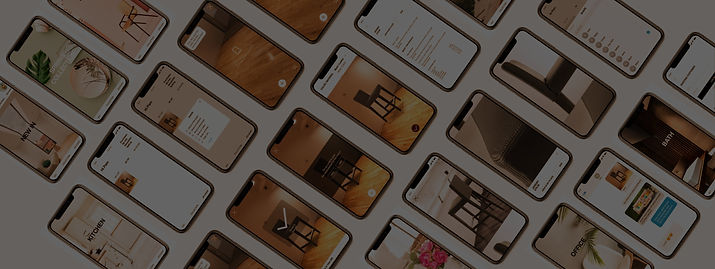
Heem
Date: January 2020
Client: Heem
Role: UX/UI Designer
Deliverables: iOS AR App
The Challenge
Enhance the furniture
shopping experience with AR
Heem, an interior design company with 10+ furniture brand partnerships, wants to create a new app with augmented reality. They want to enhance the furniture shopping experience. I was tasked with designing an iOS app that allows users to browse products and use augmented reality to see how their chosen furniture would look in their home.
Secondary Research
As someone unfamiliar with the AR/VR industry, my main focus was learning about the subject. After thorough research and analyzing competitors, I discovered that major tech companies and furniture brands are using AR to enhance shopping experiences. However, AR is still relatively new to most people, and its technology is not yet perfected. To gather more insights, I went out and talked to real people about their furniture shopping habits and opinions on AR. You can check out the complete competitive analysis for more details.
Primary Research
I interviewed six participants and visited major furniture stores, which helped me realize that customers value both in-store and online experiences when buying furniture. To better understand this, I observed how people interact with furniture, their friends and family, and store staff at Williams Sonoma, West Elm, Rafael Interiors, Homenature, and Crate & Barrel. I also studied how products were categorized, the information provided, and successful store design patterns. This gave me a deep insight into customer behaviors when shopping in-store, arranging furniture, finding inspiration, and how the in-store experience influences the overall shopping journey.
Empathy Map
Once I sorted through the data to uncover user needs, I realized that people enjoy browsing and spending time. However, I also found obstacles that hinder frequent product purchases. The empathy map findings outline these challenges, which directly relate to the needs of Heem's target users.


Define Persona
I turned the empathy map data into a persona named "Pam." This adds context and personality to the research findings, helping us understand and connect with the target user as we design.
"Furniture shopping is about total experience. I need both website and the store to make a final buying decision."

Storyboard for their journey
The client wanted AR features for a new app. To create the best AR feature for both the client and user, I began by fully understanding Pam's furniture shopping journey. I outlined her complete experience, including browsing online, store navigation, seeing furniture in her space via AR, sharing AR photos, and making the final purchase on her iPhone. This step was vital to truly connect with Pam's behaviors and insights and provide the right solution.

POV Statement + HMW Questions + Business Goals
By rigorously emphasizing research and effectively portraying the target user, I engaged in ideation to address both the challenges and aspirations faced by Pam. Subsequently, I harmonized these ideas with Heem's business objectives to identify shared objectives, thereby pinpointing the primary goals crucial for achieving a successful design resolution. For a comprehensive understanding, you're welcome to review the complete set of POV statements and HMW questions.

Requirements
After carefully distilling the salient insights from the user interview and addressing the "how-might-we" questions, I arrived at a set of focal points for resolution. I engaged in a swift and dynamic brainstorming session, strategically selecting features that align with each of Pam's requirements, taking into consideration their feasibility and potential impact. For a comprehensive overview, you're encouraged to explore the product roadmap.
Biggest Pain Points

Sitemap
Subsequently, I devised a comprehensive sitemap to visually map out the app's information architecture. Given the complexity of integrating AR features within a comprehensive online shopping platform, I encountered a unique challenge. In response, I meticulously examined the conventions adopted by prevailing furniture applications and immersed myself in the perspective of the persona, Pam. This insightful approach enabled me to discern the most instinctive and coherent manner in which to arrange the app's components. Employing the technique of card sorting, I further honed and validated the information architecture and navigational framework of the app.

User Flows
In order to comprehensively dissect the app's dynamics, I meticulously charted user flows and task flows. These constructs were informed by an overarching storyboard, which facilitated a detailed analysis of user interactions across diverse scenarios, thereby revealing the intricate interplay between different screens. This methodological approach provided me with a heightened understanding of how to sculpt intuitive user experiences by means of the user interface.

Sketches
I began designing the new features' user interface by creating rough sketches, drawing inspiration from the design pattern research. Afterward, I refined these sketches according to the iOS material guidelines. This sketching approach allowed me to share my concepts with colleagues and mentors, obtaining valuable feedback in the initial design phase.

High-Fidelity Wireframe
I created the high-fidelity wireframes include the branding and initial design sketches of main AR features and product pages for usability testing. Feel free to interact with the prototype using the button below.

Reflection
During this project, I faced a challenge in an unfamiliar subject area. This led me to focus more on research and understanding the target user group. Looking back, I had the time to design for only one persona, but the research suggests that Heem could extend its reach to other user groups who may not reside in the city or have access to partnered stores. Moving forward, a key objective would involve identifying these potential user groups and developing additional significant features to create a comprehensive shopping experience both in-store and online.
Another obstacle was the implementation of advanced AR features, which demands sophisticated technology. Consequently, conducting usability testing becomes even more crucial to ensure the product caters to varying levels of user needs.
Next Steps
-
Develop the next priority features
-
Conduct research with other target groups
-
Gather usability testing date from the target groups
-
Iterate the major UI features for handoff